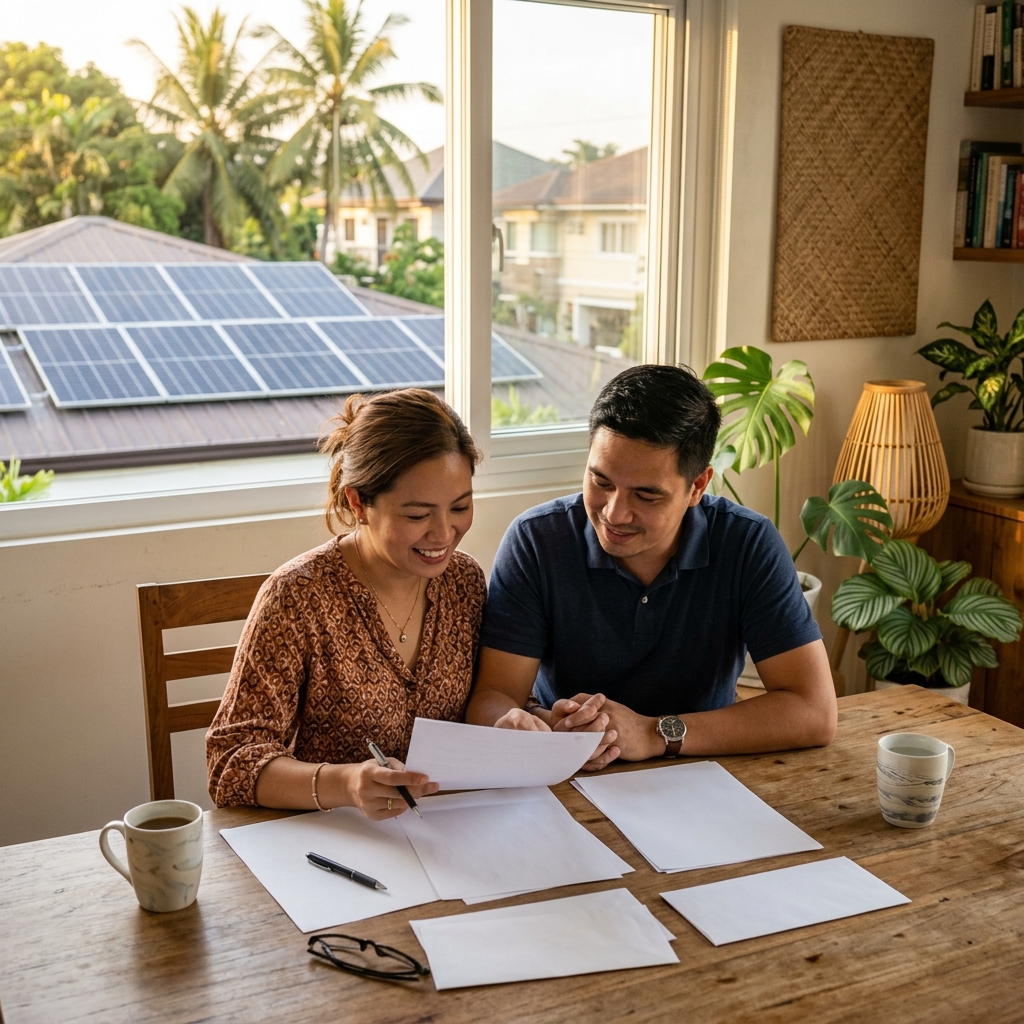
The Upfront Cost Problem — and How People Are Solving It
Solar's biggest barrier in the Philippines isn't sunlight or technology — it's the upfront cost. A quality 6KW hybrid system runs ₱450,000–₱600,000. For most Filipino families, that's not a number you pull from savings. So the financing question becomes just as important as the system itself.
The good news: there are now multiple legitimate ways to finance solar in the Philippines, and when you run the numbers, a financed solar system often costs you less per month than your current electricity bill — starting from day one.
Bank Loans for Solar
Several Philippine banks have introduced home improvement or green loan products specifically designed for solar installations. The terms vary, but here's what you'll typically encounter:
BDO Home Equity / Multi-Purpose Loan
If you have an existing BDO home loan, you can often borrow against your equity. Solar installations typically qualify as home improvements. Terms of 5–10 years with rates in the 6–9% range, depending on your profile.
BPI Family Savings / Home Loan Top-Up
BPI offers top-up loans for existing mortgage holders. Solar qualifies as an approved use. Competitive rates for good credit profiles, typically 5–8 years repayment.
RCBC, UnionBank, and Other Commercial Banks
Several other banks offer personal or home improvement loans that can be used for solar. Shop around — rates and terms differ significantly. A ₱500,000 loan at 8% over 60 months works out to about ₱10,100/month.
Quick math check: If your current Meralco bill is ₱10,000/month and solar saves you ₱8,500/month, but the loan costs ₱9,000/month — you're still paying roughly the same. But in 5 years, the loan is gone and you have free electricity for the next 20.
In-House Installment Plans
Many reputable solar companies — including SolarStream — offer in-house installment arrangements that don't require going through a bank. These can range from 12 to 36 months, sometimes with zero interest for shorter terms.
In-house financing is simpler to qualify for (no bank credit check, no collateral required in most cases) and often faster to arrange. The tradeoff is that the term is usually shorter — so monthly payments are higher than a 5-year bank loan. But you're also done faster, which means the payback clock runs faster too.
Government Programs Worth Knowing About
There are a few programs that can help, though not all are consistently funded or widely available:
- PAGCOR Green Fund / DOE programs: Periodically offer subsidized financing for renewable energy for LGUs and cooperatives. Primarily for commercial/community systems.
- Pag-IBIG Housing Loan: If you're building a new home, some Pag-IBIG loan structures can include solar as part of the construction cost.
- SSS / GSIS Multi-Purpose Loans: Can technically be used for solar, though they're not specifically designed for it. Worth checking if you're a government employee or active SSS member.
- Cooperative / MSME financing: Agricultural cooperatives and some rural banks offer equipment loans that cover solar for farms and small businesses.
Solar Lease / Power Purchase Agreements (PPA)
This model is still emerging in the Philippines but is worth knowing about. A solar company installs panels at zero upfront cost, and you pay a monthly "solar rate" for the electricity they produce — typically lower than your utility rate. You never own the system; the company maintains it.
For homeowners who want lower bills without any capital expenditure, this can make sense. For business owners, the ability to redirect capital elsewhere is attractive. The downside: you don't build equity in the system, and long-term savings are lower than ownership.
How to Actually Compare Your Options
When evaluating financing, focus on three numbers: monthly payment, total interest paid over the life of the loan, and how quickly your savings offset the payment. Here's a simple framework:
- If monthly loan payment < current electricity bill → cash-flow positive from day one ✓
- If monthly loan payment ≈ electricity bill → break-even now, pure savings after payoff ✓
- If monthly loan payment > electricity bill → you're paying a premium now; evaluate if the long-term math works for you
Does Financing Still Make Sense Financially?
Even with interest on a loan, financed solar almost always makes sense over a 25-year horizon. Consider this: your electricity rate will almost certainly be 20–40% higher in 10 years (rates have increased roughly every 2–3 years historically). Your loan payment, meanwhile, is fixed.
A family paying ₱10,000/month in electricity today will likely pay ₱14,000–₱16,000/month in 10 years. Their financed solar system, fully paid off by then, costs them zero. The compounding advantage of going solar — even on financing — is substantial.
Need financing in a specific city? We serve customers across Visayas and Mindanao. Chat with our local teams: Metro Cebu · Davao City · Cagayan de Oro · Iloilo City · General Santos
Want to Know Your Monthly Payment?
Talk to us about in-house installment options. We'll give you an honest breakdown — monthly cost, savings, and payback — before you commit to anything.
Ask About Financing