Why Are So Many Filipinos Going Solar Right Now?
Electricity in the Philippines is some of the most expensive in Southeast Asia — we're talking ₱10 to ₱13 per kilowatt-hour, and it's only trending upward. If your monthly bill is consistently above ₱3,000, you're probably already doing the math in your head.
But it's not just about the bills. Brownouts are still a reality for most of the country — sometimes a nuisance, sometimes genuinely disruptive if you work from home, run a small business, or have medical equipment that needs power. A properly installed hybrid solar system changes that equation completely.
The good news: solar has never been more affordable. Panel prices have dropped roughly 80% over the last decade, installation has become more standardized, and the payback period for a typical Filipino household is now somewhere between 3 and 6 years — after which you're essentially running on free electricity for the next 20+ years.
The Three Types of Solar Systems — and How to Choose
Not all solar systems are the same, and this is where a lot of people get confused. Your installer should walk you through the options, but here's the plain-language version:
On-Grid (Grid-Tie) Solar
This is the simplest setup. Solar panels on your roof feed directly into your home and the grid. During the day, your solar generates power and reduces what you draw from Meralco or VECO (Metro Cebu's distribution utility). Any excess goes back to the grid, and under the net metering program, you can earn bill credits for it.
The catch: when the grid goes down, your system shuts off automatically. It's a safety requirement — you can't have electricity flowing back into a grid that workers might be repairing. So if brownouts are your main concern, on-grid alone won't solve that.
Hybrid Solar with Battery Storage
This is what most Filipino homeowners actually want. Same solar panels, but with a battery bank added. During the day, you power your home from solar and charge the battery. At night or during a brownout, the battery kicks in — automatically, usually within milliseconds.
The battery also means you're never stuck in the dark mid-afternoon when a storm takes the grid out. For families with WFH setups, online businesses, or medical equipment, this is increasingly considered non-negotiable.
Off-Grid Solar
Off-grid means complete disconnection from the utility. Your solar and battery system is your only power source. This makes sense if you're in a remote area without grid access — a mountain property, an island home, a farm without nearby lines. It generally requires a larger battery bank and careful load planning, since you can't fall back on the grid if you run low.
Quick decision guide: If you have reliable grid access and brownouts are rare → on-grid. If brownouts are frequent or you work from home → hybrid. If you have no grid access → off-grid.
How Big Should Your System Be?
The honest answer: it depends on your electricity consumption. But here's a quick starting point. Look at your electricity bill — specifically the kilowatt-hours (kWh) you consumed last month.
- Monthly bill ₱2,000–₱4,000: A 3KW hybrid system is usually enough
- Monthly bill ₱4,000–₱10,000: A 5–6KW hybrid covers most or all of it
- Monthly bill ₱10,000–₱20,000: 10–15KW range
- Above ₱20,000: 15–30KW, with a proper load assessment first
A good installer won't just quote you based on your bill — they'll ask about your appliances, your usage patterns, whether you run aircon overnight, and what you want the battery to cover during a brownout. Don't skip that conversation.
Permits and Paperwork — the Part Nobody Warns You About
This is where a lot of DIY or cut-rate installations fail. Installing solar in the Philippines requires proper permit guidance, and skipping them creates problems down the line — especially if you want to apply for net metering or sell the property.
Here's what's typically required:
- Electrical permit from your LGU (Local Government Unit)
- Building permit if the installation involves structural work (most do)
- Net metering application filed with your distribution utility (Meralco, VECO, etc.) — if you want grid export credits
- PEC compliance — the installation must comply with the Philippine Electrical Code
A legitimate solar company handles all of this for you. If your installer says "permits aren't needed for small systems" or "we'll sort that later" — that's a red flag.
Need the full breakdown? Read our complete solar permit requirements guide — step-by-step application process, costs by permit type, timeline by region, and documents required for each.
What Actually Happens on Installation Day
Most residential solar installations are completed in one to two days for systems up to 10KW. Here's roughly what to expect:
- Site preparation: The team assesses your roof, marks out the panel layout, and sets up safety equipment.
- Rail mounting: Aluminum mounting rails are fixed to your roof using waterproof penetrations (done correctly, these won't cause leaks).
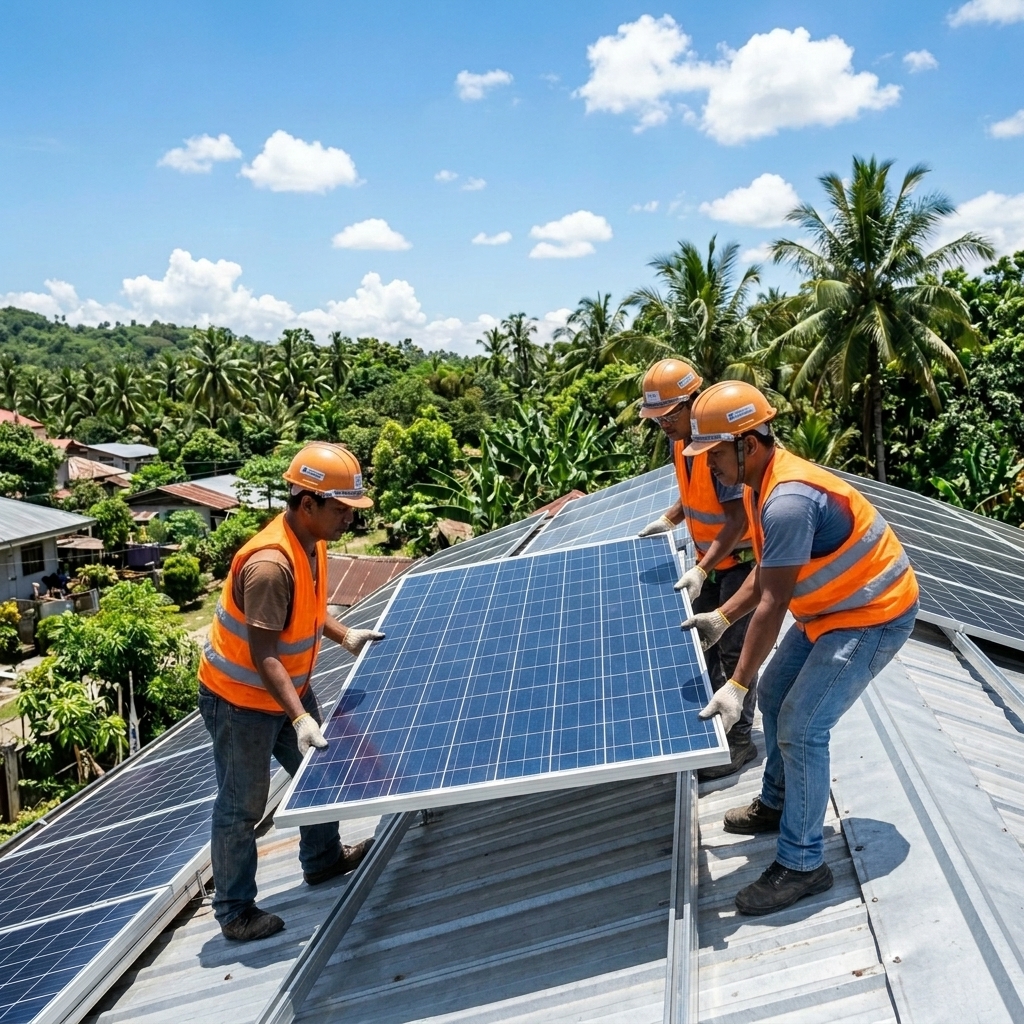
- Panel installation: Panels are lifted and secured to the rails. Each panel is connected in a string configuration.
- Inverter and battery: Installed on an interior wall — garage, utility room, or dedicated enclosure.
- Wiring and connections: DC wiring from panels to inverter, AC output connected to your main panel.
- Commissioning: The system is powered on, tested, and configured. The monitoring app is set up on your phone.
You should be present for the walkthrough at the end. Ask questions. A good installer will explain everything without making you feel like you're being rushed out.
After Installation — the First Few Weeks
The first month is genuinely exciting. You'll probably be checking the monitoring app obsessively — watching your solar production in real time, seeing your battery percentage, noticing exactly how much you're drawing from the grid versus generating yourself.
Your next electricity bill will tell the real story. Expect a meaningful reduction, though the exact amount depends on how sunny the month was and how you used your appliances. Most homeowners see a 60–90% reduction within the first billing cycle.
Heads up: The net metering application usually takes 2–4 months to get approved by the utility. During that time, your excess solar just gets exported for free. This is normal — don't let it frustrate you.
Red Flags to Watch For When Choosing a Solar Installer
Not everyone in the market is operating at the same standard. Here are things that should give you pause:
- No site assessment before quoting — a real quote requires seeing your roof, your electrical panel, and your bill
- No mention of permits or saying permits aren't needed
- Extremely low pricing with no clear breakdown of components
- No warranty on workmanship (separate from equipment warranty)
- Can't tell you what inverter brand they're installing or the cycle life of the battery
- No monitoring app or remote support after installation
Questions We Hear All the Time
Will solar panels survive a typhoon?
Quality panels mounted correctly are rated for wind speeds of 180km/h or higher — that's stronger than most Philippine typhoons. The mounting system matters as much as the panels themselves. Always ask your installer about their mounting specifications.
Do I need to clean my solar panels?
In the Philippines, rain does most of the job. During long dry seasons, a simple rinse with water (not high pressure) every month or two is enough. Don't use soap or abrasive materials on the panel surface.
What happens to my system during a typhoon?
Your inverter will shut down automatically if it detects unsafe grid conditions. Hybrid and off-grid systems can continue running in battery mode during and immediately after a typhoon — which is exactly when you need power most.
Installing in Visayas or Mindanao? Permit timelines and net metering requirements vary by utility and LGU. SolarStream operates across the region — see the guide for your area: Metro Cebu · Davao City · Cagayan de Oro · Iloilo City · Bacolod
Ready to Go Solar? Start with a Free Assessment.
SolarStream does a free site assessment covering your roof, your bill, and your load requirements — no obligation, no pressure. We give you the real numbers.
Book Free Assessment