The Confusion Most People Have
When you start researching solar in the Philippines, you'll quickly encounter three terms — on-grid, hybrid, and off-grid — and it's not always clear what they mean or why it matters. A lot of sales conversations conflate these, which leads to people buying a system that doesn't solve their actual problem.
The main mistake? People buy an on-grid system because it's cheaper, and then are surprised when it shuts off completely during a brownout. That's not a malfunction — it's how on-grid systems are designed to work. Let's break this down clearly.
Grid-Tie Solar
Solar + Grid. No battery. Shuts off during brownout.
Hybrid Solar
Solar + Battery + Grid. Automatic switchover during brownout.
Off-Grid Solar
Solar + Battery only. No grid connection at all.
On-Grid (Grid-Tie) Solar: The Basics
A grid-tie system connects your solar panels directly to the grid through a string inverter. During the day, solar powers your home. Surplus goes to the grid (and under net metering, earns you credits). At night, you draw from the grid as normal.
It's the simplest and cheapest configuration. No batteries means lower cost and lower maintenance. The inverter is also simpler and cheaper.
The critical limitation: Grid-tie systems have anti-islanding protection — they must shut down when the grid goes down. This is a safety requirement to protect utility workers during repairs. So during a brownout, your system is completely offline — even if the sun is shining brightly on your panels. This surprises a lot of buyers.
When on-grid makes sense: If you live in an area where brownouts are genuinely rare (some parts of Metro Manila now), and your primary goal is reducing the electricity bill rather than brownout protection, on-grid is worth considering for the cost savings.
Hybrid Solar with Battery: Why Most Filipinos Choose This
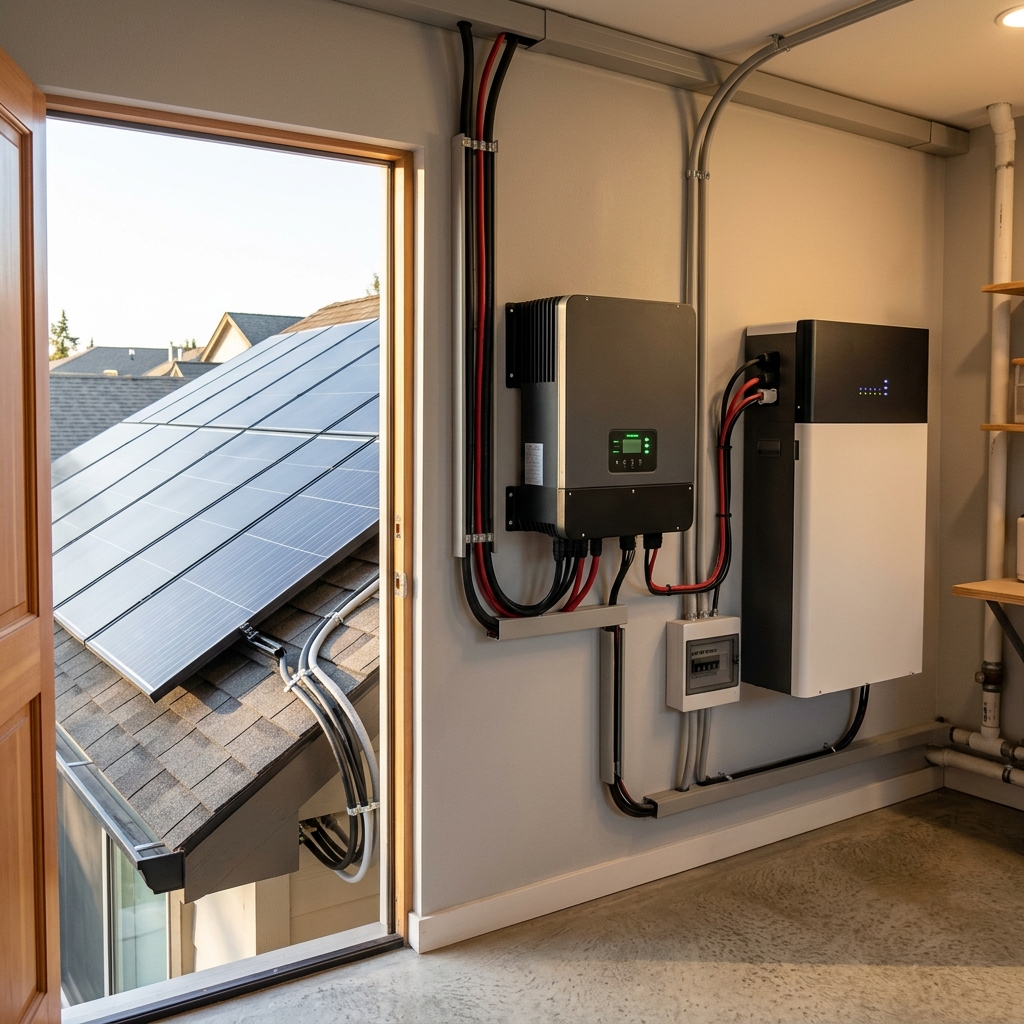
A hybrid system adds a battery bank and a more sophisticated hybrid inverter. The inverter constantly manages three power sources: solar panels, battery, and grid. It decides in real-time where power comes from and where it goes.
During a brownout, the system automatically switches to battery power — typically in under 20 milliseconds, so seamlessly that your computer doesn't crash and your refrigerator doesn't miss a beat. When the grid comes back, it seamlessly reintegrates.
This is why hybrid has become the default recommendation for most Philippine homes. Brownouts are still a common reality across the country, working from home has become normal, and the cost difference between on-grid and hybrid has narrowed significantly.
Typical setup: 6KW solar + 10KWh LiFePO4 battery + hybrid inverter. Powers a medium Filipino home 80–90% from solar, with 8–12 hours of battery backup during brownouts.
Off-Grid Solar: When It Makes Sense
Off-grid means complete independence from the utility — no grid connection, no grid bills, no brownouts. Your solar panels and battery bank provide 100% of your power. This is the right choice when your property has no grid access (remote province, island, mountain area), or when diesel generator costs over 10 years exceed the solar investment.
Off-grid systems require larger battery banks (2–3 days of autonomy) and cost 40–60% more than equivalent hybrid systems. But compared to a generator, they save P1.7 million+ over 10 years.
Deep dive: Read our complete off-grid solar system guide — sizing, costs, battery bank calculations, island installations, and community microgrids.
Side-by-Side Comparison
| Feature | On-Grid | Hybrid | Off-Grid |
|---|---|---|---|
| Works during brownout | No | Yes | Yes |
| Battery required | No | Yes | Yes (larger) |
| Grid connection | Yes | Yes | No |
| Net metering eligible | Yes | Yes | No |
| Relative cost | Lowest | Mid | Higher |
| Best for | Low-brownout areas | Most PH homes | Remote locations |
The Philippine Brownout Factor
This is the most important consideration that's specific to the Philippines. In Singapore or Germany, on-grid solar is the default because grid reliability there is 99.99%+. In the Philippines, even Manila's distribution system still experiences unplanned interruptions.
For areas outside of NCR — Cebu, Davao, provincial areas — brownouts can range from occasional to daily. In these contexts, an on-grid system is barely an improvement over having no solar at all from a reliability standpoint. Hybrid is effectively the minimum viable solution.
So Which One Should You Actually Get?
Here's a plain decision matrix:
- Brownouts once a month or more, work from home, or have medical equipment: Hybrid, full stop.
- Brownouts rare or non-existent, just want to cut the bill: On-grid is a reasonable option.
- No grid access, remote location: Off-grid with proper battery sizing.
- Have some grid access but it's unreliable (island, far province): Hybrid with larger battery, perhaps generator backup as well.
The bottom line for most Filipinos: Hybrid is the right answer. The cost premium over on-grid has come down, the brownout protection is now considered standard, and the peace of mind during typhoon season alone is worth it.
The right system type depends on your utility and local brownout frequency. See area-specific recommendations for major cities:
Not Sure Which System Fits Your Situation?
A free assessment helps us understand your brownout frequency, load requirements, and budget — so we can recommend exactly what makes sense for your home.
Get a Free Assessment