How Solar Panels Actually Work
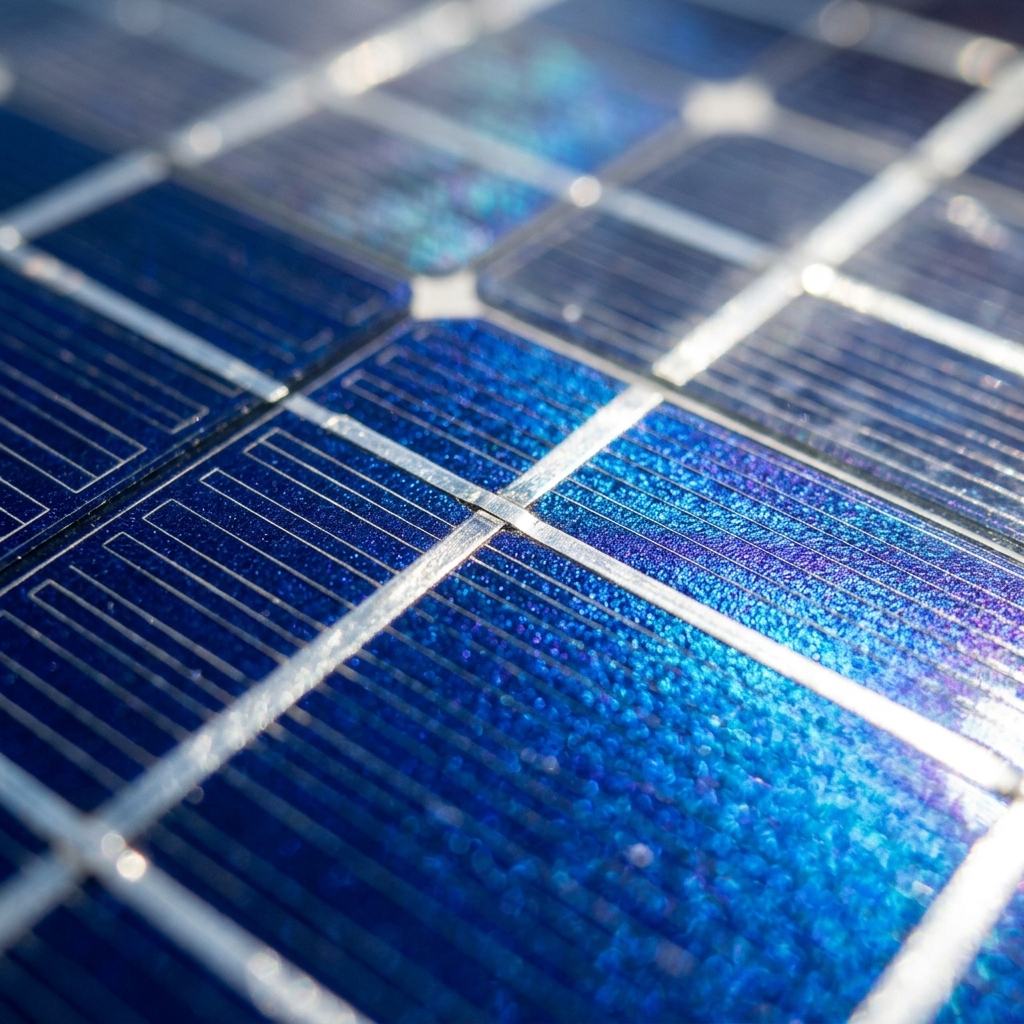
A solar panel is essentially a sandwich of silicon cells. When photons from sunlight hit the silicon, they knock electrons loose and create a flow of direct current (DC) electricity. Multiple cells make up a panel, multiple panels make up an array, and the inverter converts that DC into AC for your home.
The efficiency of this conversion — how much of the sunlight hitting the panel becomes electricity — is one of the key specs you'll compare between panels. Higher efficiency means more power from the same roof area, which matters a lot when roof space is limited.
Monocrystalline vs Polycrystalline — Does It Still Matter?
Ten years ago, the mono vs poly debate was significant. Today, polycrystalline panels have largely disappeared from the market. Nearly every panel sold in the Philippines in 2024–2026 is monocrystalline — specifically PERC (Passivated Emitter and Rear Contact) or TOPCon monocrystalline.
Here's a quick summary for reference:
| Type | Efficiency | Philippines Market Status | Cost |
|---|---|---|---|
| Polycrystalline | 15–17% | Mostly phased out | Lowest (but hard to find) |
| Mono PERC | 19–21% | Current standard | Mid-range, widely available |
| Mono TOPCon | 21–23% | Premium, becoming standard | 10–20% premium over PERC |
| HJT (Heterojunction) | 23–25% | Limited local availability | Highest |
For most Filipino homes, Mono PERC panels in the 460–580W range are the practical choice — good efficiency, excellent availability, proven performance, and competitive pricing. TOPCon panels are worth the modest premium if you have limited roof space and need maximum output per square meter.
What About Bifacial Panels?
Bifacial panels generate power from both sides — the front from direct sunlight, and the back from reflected light off the roof or ground surface. They're worth considering for flat roof installs with light-colored surfaces, or ground-mounted systems with good albedo (ground reflectiveness).
For most sloped residential roofs in the Philippines, bifacial panels offer only marginal real-world gains over standard monofacial panels — typically 5–10% more production in optimal conditions. The premium can be justified for large systems but often isn't necessary for residential scale.
Understanding Wattage Ratings
Panel wattage (e.g., "550W panel") is the rated output under STC — Standard Test Conditions, which is 25°C and 1,000 W/m² irradiance. Never in the Philippines. Actual output in Philippine conditions will typically be 75–85% of STC rating.
This is why you can't simply multiply panel wattage by hours and expect to see that number on your monitoring dashboard. A 550W panel might produce 420–470W consistently in real Philippine conditions during peak hours. This is normal and is accounted for in a proper system design.
Watch out for: Installers who quote "daily production" based on STC wattage without applying derating factors. Ask specifically what production figure they used to size the system and what assumptions they made about your location's Peak Sun Hours (PSH — typically 4.5–5.5 for most Philippine locations).
The Temperature Coefficient — Crucial in the Philippines
Here's a spec most buyers ignore but shouldn't: the temperature coefficient (Pmax). It tells you how much a panel's output drops for every degree above 25°C. In the Philippines, roof-mounted panels can reach 60–70°C on hot dry days.
A typical panel has a temperature coefficient of -0.35% to -0.40% per °C. At 60°C (35°C above STC), that's a 12–14% output loss just from heat. Better panels have lower coefficients (-0.25% to -0.30%), meaning less performance penalty in our climate. If two panels are similar in price and efficiency, choose the one with the lower (less negative) temperature coefficient.
Panel Brand Tiers in the Philippines
The global solar panel market is dominated by Chinese manufacturers, and the Philippine market reflects this. Here's how to think about brand tiers:
- Tier 1 (Bankable): LONGI, JA Solar, Trina, Jinko — these are the most widely installed brands globally, with strong financial backing and consistent quality. These are the safe choices for most Filipino homeowners.
- Tier 2: Canadian Solar, Risen, Astronergy — solid brands with good performance and reasonable local availability.
- Unknown/no-name: Avoid. Philippine laws don't ban the importation of unbranded panels, and some installers use them to compete on price. You have no warranty recourse and no data on long-term performance.
Quick tip: Ask your installer for the panel's full model number, then look it up on the manufacturer's website and verify that the specs match what you were quoted. Legitimate panel brands have searchable datasheets.
What Warranties Should You Expect?
Solar panels come with two distinct warranties:
- Product warranty (materials/workmanship): Typically 10–12 years. Covers manufacturing defects, delamination, cracks, and similar failures.
- Performance warranty (linear degradation): Typically 25–30 years. Guarantees that the panel produces at least 80–85% of rated power at the end of the warranty period. Most Tier 1 panels lose less than 0.5% efficiency per year, so reaching year 25 with 87–90% output is common.
If a panel only comes with a 5-year product warranty, that's a red flag for the quality of the cell and encapsulant materials. Quality panels today offer at least 10 years on materials and 25 years linear performance warranty.
Questions to Ask Your Solar Installer About Panels
- What brand and model is this panel — can I see the datasheet?
- What efficiency rating and temperature coefficient does it have?
- Is this panel Tier 1? Who is the manufacturer (not just the brand)?
- What are the product and performance warranties, and who do I contact for a claim?
- Is the panel certified to IEC 61215 and IEC 61730 standards?
- What Peak Sun Hours did you use to calculate my expected production?
A good installer answers all of these confidently and in writing. An evasive response to any of them — especially the brand/manufacturer question — is a reason to shop around.
Panel choice and system sizing also depends on your local utility rates and roof conditions. See city-specific solar guides:
Ready to Talk About the Right Panels for Your Roof?
SolarStream sources only Tier 1 panels with full Philippine distributor warranty support. Book a free assessment and we'll tell you exactly what system we'd install and why.
Get a Free Assessment