What Is LiFePO4 — And Why Does Everyone Keep Saying It?
LiFePO4 stands for Lithium Iron Phosphate — a specific chemistry of lithium battery. If you've been researching solar storage in the Philippines, you've probably noticed that most reputable installers specify LiFePO4 batteries. There's a good reason for that.
Not all lithium batteries are created equal. The other main lithium chemistry — NMC (Nickel Manganese Cobalt) — is what's in your phone and laptop. It's energy-dense but can overheat, catch fire, or degrade faster in high temperatures. LiFePO4 trades some energy density for something more valuable in the Philippines: thermal stability, long cycle life, and safety.
Why LiFePO4 is Particularly Well-Suited for the Philippines
The Philippine climate is both beautiful and brutal on electronics. Average temperatures of 27–35°C, humidity above 80%, and occasional brine-laden sea air in coastal areas create a challenging environment for batteries.
- Thermal stability: LiFePO4 operates safely at temperatures up to 60°C and doesn't undergo thermal runaway — the runaway heating reaction that makes NMC batteries a fire risk. In a hot Philippine summer, this matters.
- Humidity tolerance: LiFePO4 cells are more tolerant of high ambient humidity than some other lithium chemistries, especially when properly housed in BMS-protected enclosures.
- Long cycle life: In tropical conditions with daily cycling, LiFePO4 batteries maintain their performance longer than lead-acid or NMC alternatives.
LiFePO4 vs Lead-Acid: The Numbers That Matter
| Comparison | LiFePO4 | Lead-Acid (AGM) |
|---|---|---|
| Usable capacity (DoD) | 80–100% | 40–50% |
| Cycle life | 3,000–6,000 cycles | 300–600 cycles |
| Expected lifespan | 10–15 years | 2–4 years |
| Weight for same usable energy | ~50% lighter | Heavier |
| Thermal runaway risk | Essentially none | Hydrogen gas risk |
| Upfront cost | Higher | Lower |
| 10-year total cost | Lower (no replacement) | Higher (2–3 replacements) |
The lead-acid argument always comes down to upfront cost. But when you factor in that you'll replace lead-acid 2–3 times in the same period a single LiFePO4 pack serves you, the math flips quickly. For a 10KWh lead-acid bank at ₱80,000 replaced twice, you've spent ₱240,000 in 10 years. A 10KWh LiFePO4 at ₱120,000 once gets you further.
How Long Does a LiFePO4 Battery Actually Last?
A quality LiFePO4 battery bank is rated for 3,000–6,000 cycles at 80% Depth of Discharge. One full charge-discharge cycle per day = 3,000 days minimum = over 8 years. Most systems last 10–15 years in Philippine conditions.
After those cycles, the battery doesn't die — it gradually loses capacity. At cycle 3,000, you'll typically still have 80% of original capacity (that's the standard warranty threshold). You might not notice the difference in daily use for another year or two.
Warranty note: The industry standard LiFePO4 warranty in the Philippines is typically 5 years on the battery unit, with 10-year design life claims. Ask for the cycle life rating specifically — 3,000 cycles minimum is the baseline.
How to Size Your Battery Bank
Battery sizing in the Philippines is really a brownout question: how many hours of brownout do you want to be covered for, and which appliances do you want running during that time?
Here's a practical approach:
- List your critical loads — refrigerator (~150W), WiFi router (~20W), lights (~60W), fans (~80W each), internet modem (~10W)
- Add up the wattage and estimate how many hours you need coverage
- Divide by 1,000 to get kWh, multiply by 1.2 (20% safety buffer)
- That's your minimum battery capacity
Example: ref + 3 lights + 2 fans + WiFi = roughly 500W. For 10 hours = 5kWh minimum → a 5.12kWh battery module covers basic loads. For 2 aircon units added = size up to 10kWh or more.
What a 10KWh Battery Really Powers During a Brownout
A 10KWh battery bank at 80% DoD gives you 8 usable kWh. Here's what that realistically powers for a medium Filipino home:
- Refrigerator running continuously ✓
- Internet router and modem ✓
- 6–8 LED lights ✓
- 3–4 ceiling fans or stand fans ✓
- 55" TV for 4–5 hours ✓
- Laptop and phone charging ✓
- One 1HP aircon for 5–6 hours ✓ (with careful use)
And if it's daytime and the sun is out, your solar keeps recharging the battery simultaneously — so the brownout duration matters much less than if it hits at night.
Is It Safe to Install Indoors?
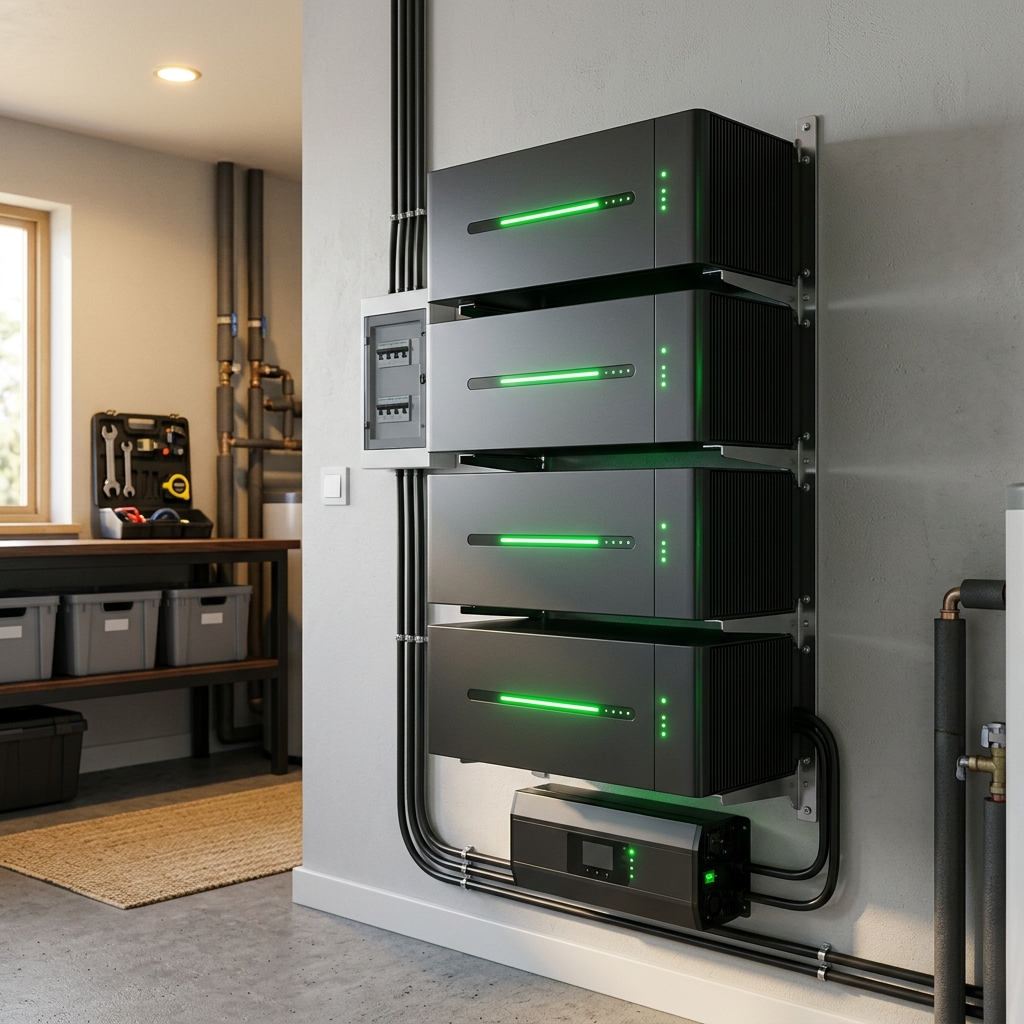
Yes, and this is one of the key advantages of LiFePO4 over lead-acid. Lead-acid batteries emit hydrogen gas during charging — which is why they require ventilated, dedicated battery rooms. LiFePO4 batteries don't produce gases and don't undergo thermal runaway, making them safe to install in a utility room, garage, or even a closet with basic air circulation.
Every LiFePO4 battery module includes a Battery Management System (BMS) that monitors temperature, voltage, and current — automatically disconnecting if anything goes out of range. Properly installed LiFePO4 systems don't require special fire suppression or gas detection systems.
Questions We Hear Most Often
Can I add batteries to my existing solar system?
Possibly. If your existing inverter is a hybrid-compatible model, adding batteries is usually straightforward. If it's an older string inverter, you'd need to replace the inverter as well. SolarStream can assess your current setup and advise on the retrofit cost.
What brands of LiFePO4 batteries are available in the Philippines?
The most common in the Philippine market are BYD, Pylon Tech, CATL-based modules, and various Hubble and Generic-BMS brands. BYD and Pylon Tech have the strongest track records and best local support. Don't buy batteries without checking local parts/BMS support availability.
Do batteries need maintenance?
Minimal, compared to lead-acid. LiFePO4 batteries benefit from an occasional full charge cycle (letting them charge to 100% rather than the storage-optimized 80–90%), and keeping them in a well-ventilated space. Beyond that, the BMS handles everything automatically.
Battery sizing needs vary by location — brownout frequency, utility rates, and typhoon exposure all affect the right battery capacity for your area.
Want to Know What Battery Size Makes Sense for Your Home?
A free site assessment includes a load analysis and battery sizing recommendation — based on your actual appliances and brownout patterns.
Get Free Battery Assessment